
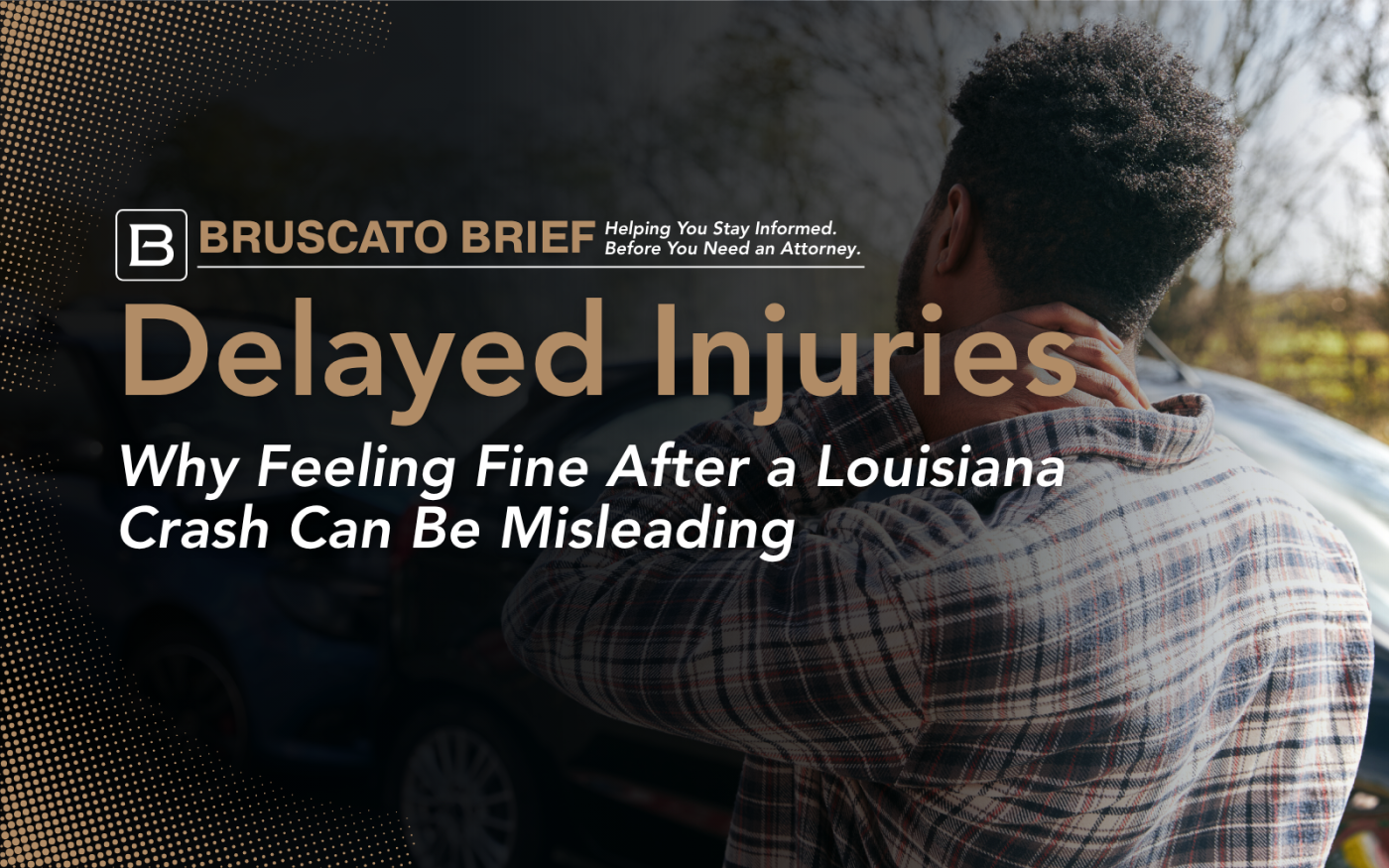
Delayed Injuries: Why Feeling Fine After a Louisiana Crash Can Be Misleading
You walk away from a car accident, shaken but seemingly unhurt. You tell the officer you're okay. You decline the ambulance. You go home, maybe even back to work the next day. Then, two or three days later, your neck stiffens, headaches set in, your lower back locks up, and you realize something is wrong.
This is one of the most common — and most misunderstood — patterns after a collision. Many serious injuries do not announce themselves at the scene. If you were in a crash in the Monroe or Ruston area, understanding delayed injuries can protect both your health and your legal rights.
Why injuries show up late. In the moments after a crash, your body floods with adrenaline and endorphins. These natural chemicals dull pain and let you function through a crisis — which is exactly why you can feel fine while injured. As that chemical surge fades over the following hours and days, the true extent of the damage begins to surface. Soft-tissue injuries in particular, like whiplash, tend to worsen as inflammation builds. The absence of pain at the scene is not proof that you escaped injury.
Some of the most frequently delayed injuries include:
Whiplash and neck strain. The violent back-and-forth motion of a crash can injure the soft tissues of the neck, with stiffness and pain often peaking a day or more after impact.
Back injuries. Herniated discs and other spinal injuries can develop gradually, sometimes radiating into pain, numbness, or tingling in the arms or legs.
Concussions and brain injuries. Symptoms like headaches, dizziness, confusion, memory problems, mood changes, or trouble sleeping can emerge hours or days after a blow to the head — even one that did not seem serious.
Internal injuries. Abdominal pain, deep bruising, or dizziness can signal internal bleeding or organ damage, which is a medical emergency.
Emotional and psychological injuries. Anxiety, trouble sleeping, flashbacks, and a fear of driving can develop in the days and weeks after a frightening crash.
Why the delay matters for your claim. Here is the problem: when there is a gap between the accident and your first medical visit, insurance companies use it against you. Their favorite argument is that if you were really hurt, you would have seen a doctor immediately — and that whatever is wrong now must have come from something else. A delay in treatment gives them an opening to question whether the crash caused your injuries at all. This is not fair, because it ignores how the human body actually responds to trauma. But it is a reality of how claims are handled, and it is why prompt medical care is so important.
See a doctor even if you feel okay. The single best thing you can do after any significant crash is to get checked out promptly — ideally within a day or two — even if you feel fine. A medical professional can catch injuries you cannot feel yet, and the visit creates a record that ties your condition to the accident. If new symptoms appear later, go back. Following through on recommended care is not only good for your health; it builds the documented, connected timeline that protects your claim.
Keep a record of how you feel. Because delayed injuries evolve, it helps to keep a simple journal: when symptoms started, how they change, what activities you can no longer do, and how the injuries affect your daily life and work. This kind of contemporaneous record can be surprisingly persuasive, because it captures the reality of your recovery as it happens.
Be careful about early settlement offers. Insurance companies sometimes move quickly to settle a claim before the full extent of an injury is known — a fast check, a release to sign, and the matter is closed. The danger is that once you accept a settlement and sign a release, you generally cannot go back for more, even if a minor injury turns out to require surgery months later. You should understand the full scope of your injuries before you agree to settle anything. What looks like a generous early offer can fall far short of what you actually need.
Louisiana's collateral source rule can protect you. In Louisiana, the fact that your own health insurance paid some of your medical bills generally does not let the at-fault party off the hook for those costs. This is one more reason not to assume your claim is handled just because insurance is covering treatment in the short term.
Don't wait too long — deadlines are strict. Delayed symptoms do not extend your legal deadlines. In Louisiana, the period to file most personal injury lawsuits is now two years for injuries occurring on or after July 1, 2024 (a one-year deadline applies to older injuries). The clock generally runs from the date of the accident, not the date your pain finally became undeniable. Waiting to see whether symptoms go away on their own can quietly eat into the time you have to protect your rights.
How Bruscato Law can help
Delayed-injury cases are exactly the kind insurance companies like to fight, because the gap between the crash and the diagnosis gives them room to argue. At Bruscato Law, we know how to connect the dots — linking your symptoms to the collision with medical evidence and a clear timeline, and pushing back when an insurer pretends your injuries came out of nowhere. We make sure you don't settle for less before you know how badly you were hurt.
If you were in a car accident in the Monroe or Ruston area and symptoms have shown up in the days since, contact Bruscato Law for a free, no-obligation consultation. Call us at (318) 855-1613. There is no fee unless we win your case, and we'll handle the insurance company so you can focus on getting better.
This blog post is for informational purposes only and does not constitute legal advice. Every case is different, and reading this article does not create an attorney-client relationship. For advice about your specific situation, please consult a licensed Louisiana attorney.